Beyond Government Reserves: What the Market Wants to Know About Quantifying Fiscal Risk
An introduction of the RiskReserves Tool to nongovernmental organizations sparked questions about resilience investments, climate projections, municipal borrowing, and the future of public-sector risk analytics.
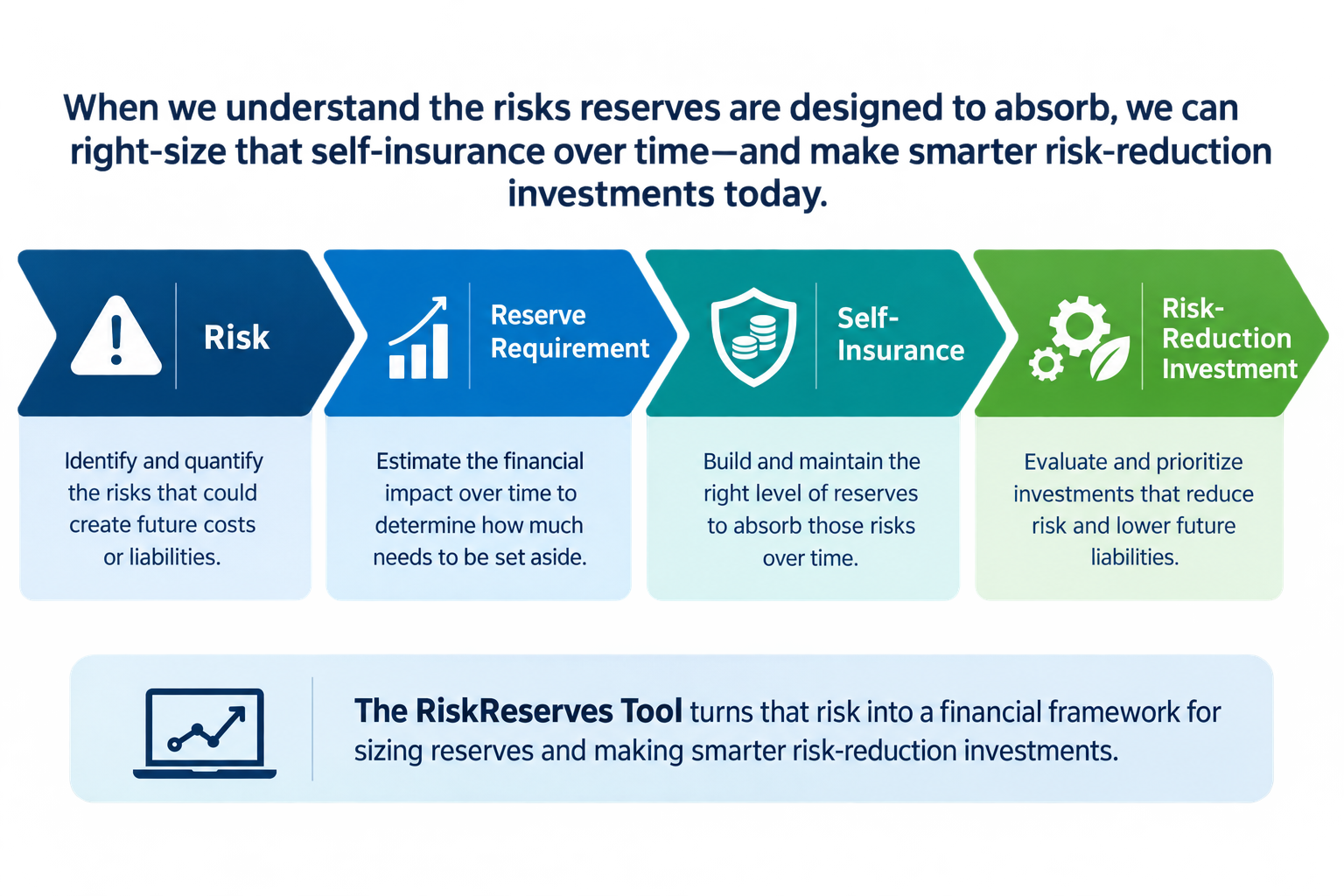
Watch the webinar here.
Key Takeaways
1. Quantifying the value of resilience: RRT can translate avoided disaster losses into measurable fiscal benefits, helping governments and investors build stronger financial cases for resilience investments.
2. Connecting physical risk to public finance: RRT moves beyond estimating disaster damages to quantify how physical risks affect government budgets, revenues, and long-term financial stability.
3. Expanding into financial markets: RRT has the potential to become a municipal fiscal stress-testing platform that helps lenders, insurers, and investors evaluate credit exposure, government preparedness, and resilience investment opportunities.
An introduction of the RiskReserves Tool to nongovernmental organizations sparked questions about resilience investments, climate projections, municipal borrowing, and the future of public-sector risk analytics.
What happens when a government can put a dollar value on the financial risks it faces from natural disasters, economic downturns, and other fiscal shocks? And what could that information mean for the organizations that finance, insure, advise, and invest in those governments?
Those questions were at the center of a recent webinar hosted by The Resiliency Company and the Government Finance Officers Association (GFOA), introducing the RiskReserves Tool (RRT) to an audience of nongovernmental organizations and private-sector participants.
Unlike previous demonstrations conducted with more than 50 public jurisdictions, this session was designed to explore what the platform could offer organizations operating outside government. The webinar introduced the tool's analytical capabilities, but the most revealing insights emerged during the question-and-answer session.
The questions pointed toward a broader opportunity: translating physical and economic risks into financial information that can inform decisions about infrastructure investment, risk transfer, municipal credit, and resilience financing.
From reserve adequacy to financial risk management
RRT began with a question familiar to government finance officers: How much money should a government maintain in reserves?
Developed through collaboration among GFOA, The Resiliency Company, and technology partner Earthena, the platform uses probabilistic modeling to evaluate a government's financial exposure to multiple risks. These include natural disasters, recessions, property tax impairment, infrastructure disruption, and uncertainty surrounding federal disaster assistance.
Through 10,000 simulations, the tool evaluates potential financial outcomes and allows governments to compare those exposures with existing reserves, budget capacity, and other financial resources. Users can also test alternative assumptions, including changes in FEMA reimbursement policies, expenditure reductions, and reserve levels.
The objective is to move beyond traditional reserve targets toward a more evidence-based assessment of fiscal preparedness.
As Matt Posner, head of public finance at The Resiliency Company, explained, the original reserve question is ultimately about something larger: "What are the financial risks that government is actually carrying?"
For nongovernmental participants, that distinction is consequential. The same information used to assess a government's reserve policy could eventually help outside organizations understand its financial vulnerabilities, evaluate proposed resilience investments, or assess its capacity to absorb future shocks.
But turning that possibility into practical applications requires answering several important questions.
Can resilience investments be valued through avoided government losses?
One of the first audience questions addressed how RRT determines the financial benefits of mitigation investments. Are reductions in expected losses supplied by users, derived from asset characteristics, or calculated through the underlying models?
The question goes directly to a persistent challenge in resilience financing: establishing an economic justification for preventive investments.
Posner described two West Coast jurisdictions evaluating wildfire mitigation programs. In one case, the amount available for investment was determined by what a politically acceptable surcharge on utility bills could raise, rather than by the government's actual wildfire exposure.
RRT offers a different starting point: estimating the financial liability before an intervention and comparing it with the expected liability afterward.
Shayne Kavanagh of GFOA illustrated the approach through a floodwall example. By maintaining consistent hazard conditions across 10,000 simulations, analysts can compare outcomes with and without an infrastructure improvement, estimating how many losses the intervention could prevent.
Karan Chopra of Earthena emphasized that the benefit extends beyond avoided physical damage. A mitigation investment can affect multiple financial categories within a government budget, including emergency expenditures, infrastructure costs, and revenue losses.
"The whole point around this then being translated into the different ways in which the financial consequence flows through to the public purse, is that now we can actually capture that financially," Chopra explained.
This distinction could be particularly important for resilience developers, infrastructure investors, and lenders seeking to demonstrate the fiscal value of their projects.
How do physical hazards become government financial liabilities?
Another audience question challenged the fundamental methodology: How does a catastrophe model built around physical damages translate those impacts into actual government costs?
The panel explained that RRT disaggregates disaster-related expenditures into categories informed by FEMA records, including debris removal, emergency services, roads, bridges, utilities, and public buildings. It also models revenue risks, using national recession data alongside jurisdiction-specific assumptions about how tax collections respond to economic downturns.
The question highlighted a critical distinction between estimating damage to a community and estimating the financial consequences for the government serving it.
For insurers, physical damage estimates may be sufficient for certain underwriting decisions. For public finance, however, the analysis must identify which losses become governmental obligations, which reduce revenues, and which are borne elsewhere.
The discussion also addressed smaller, recurring hazards that do not trigger federal disaster declarations.
Rory Fitzpatrick of Earthena described how winter storms can create recurring government expenditures that exceed ordinary operating budgets without ever qualifying for federal reimbursement. The analytical challenge is determining the additional fiscal burden associated with a particularly severe event.
These questions underscored the value of modeling risks through government budgets rather than treating physical losses as interchangeable with public liabilities.
Can the platform account for a changing climate?
The discussion also examined whether the tool could incorporate future climate conditions rather than relying solely on historical probabilities.
Chopra explained that the underlying architecture could accommodate changes in observed climate patterns, seasonal phenomena such as El Niño, and longer-term climate scenarios.
He emphasized that these capabilities remain on the development roadmap rather than being fully incorporated into the current RRT.
The distinction matters because many infrastructure investments have useful lives measured in decades. A financial assessment based on today's hazard environment may not adequately capture future exposure.
Integrating forward-looking climate scenarios would allow users to evaluate how changing hazards could alter both government liabilities and the benefits of mitigation investments over time.
Could this information eventually influence municipal borrowing?
Perhaps the most commercially consequential question concerned whether projected mitigation benefits could support borrowing capacity and whether lenders or bond counsel had accepted such calculations in actual transactions.
Posner acknowledged that no transactions had yet relied on RRT's estimates in that way.
"The short answer is no. No one has signed off on a number in an actual transaction," he said.
Instead, the near-term opportunity may be incorporating the analysis into municipal disclosures and financial reporting, allowing market participants to become familiar with quantified fiscal exposure before using the estimates directly in financing structures.
The team has engaged municipal advisors, investment banks, and rating agencies to explore those applications.
Kavanagh also distinguished between benefits accruing directly to a government's finances and broader benefits to residents and businesses. The current architecture focuses on governmental exposure, although its modular design could accommodate community-level benefits in future applications.
That distinction could become essential as resilience investments seek financing based on multiple beneficiaries and sources of economic value.
What the questions tell us about the next phase
Taken together, the webinar questions revealed interest in three interconnected applications: establishing the financial value of mitigation, improving the measurement of government fiscal exposure, and translating those findings into information usable by financial markets.
They also exposed important development priorities, including stronger integration of project-level mitigation data, forward-looking climate scenarios, and clearer pathways for incorporating risk analysis into municipal financial reporting.
The Resiliency Company is now beginning a nine-jurisdiction cohort designed to test the platform in real government decision-making. That process will provide additional opportunities to refine the methodology and explore applications beyond reserve adequacy.
For nongovernmental organizations, the opportunity is not simply to access another risk model. It is to connect physical risk analysis with the financial decisions that determine how public resources are allocated.
The webinar suggested that the next stage of RRT's development will be shaped as much by the questions asked outside government as by the decisions made within it.